IL GIARDINO DELLE COSE SPERSE
NON-VERBAL: Art installation with no text.
WHERE DO OUR MEMORIES END UP?
In the garden, memories are kept safe.
Laid to rest, they find a place to belong, a place to call home.
Some memories ask to be preserved, others to be silenced.
There is room for all of them in the garden.
Memories, recollections, moments that happened in a meaningful present.
The lost things that tell something about me when I am silent.
THE PROJECT
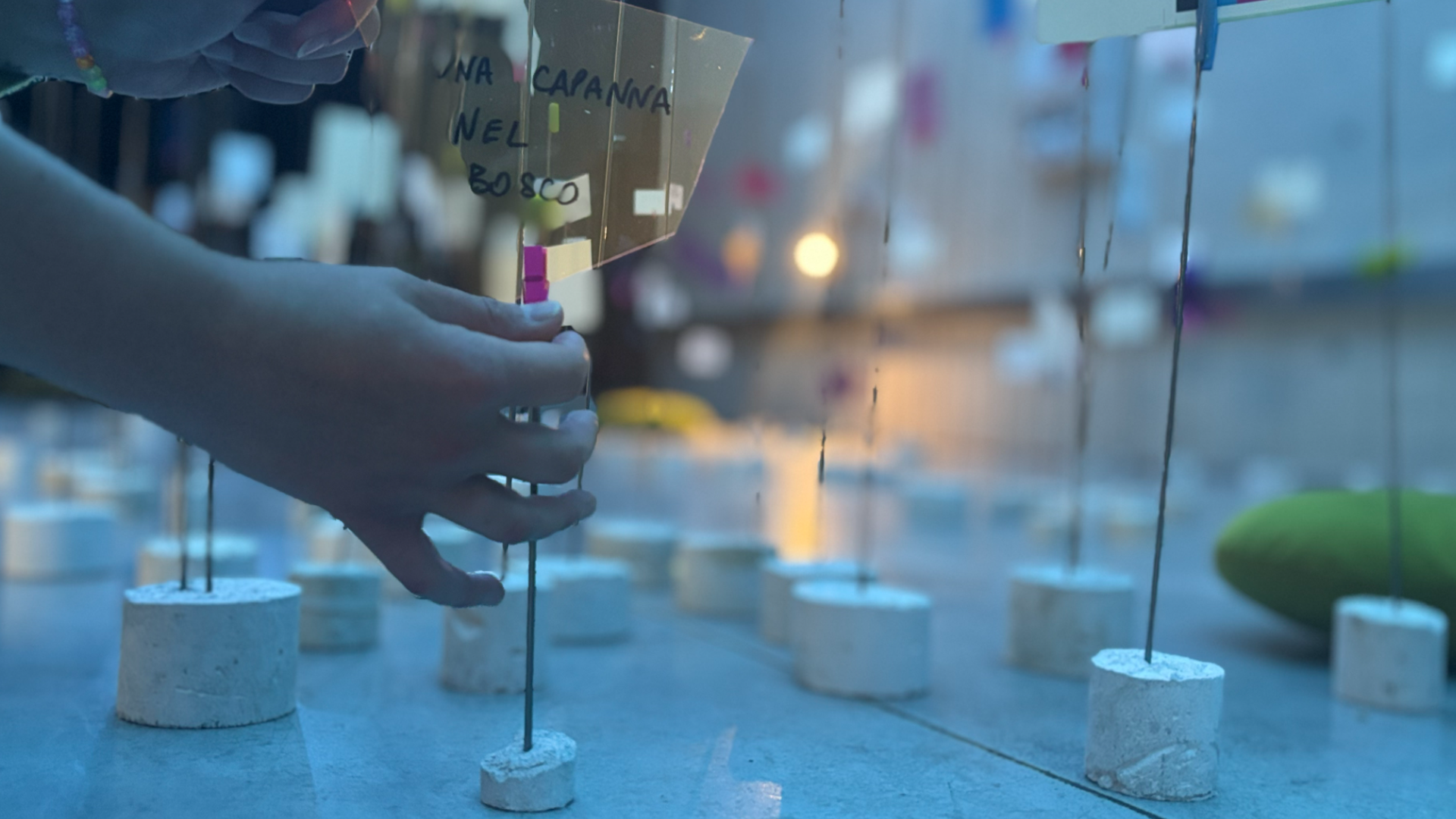
The installation takes the form of an artificial garden made up of flowers created from recycled and reclaimed materials. It features 300 small concrete bases, each holding an iron rod of varying height. At the top, a wooden peg holds a sheet of paper bearing a memory. Together, these elements create a dense, walkable landscape: a small labyrinth of flowerbeds and pathways where visitors can move freely, read and pause. Each sheet holds a personal, anonymous and real memory.
Visitors can choose if and how they wish to participate, as the garden features two different stations. At the writing and drawing station, there are sheets of paper and card on which visitors can write or draw their own memory. At the sound station, a microphone allows them to record their memory, which then becomes part of a shared soundscape. The collected voices intertwine in a continuous, light and layered chorus that moves through the space like a natural element, reminiscent of the wind moving through flowers.
This chorus accompanies the experience discreetly, creating a subtle, ever-present atmosphere.
Alongside the possibility of leaving something behind, there is also the possibility of taking something away. If a memory resonates with someone who encounters it, the sheet can be removed and taken elsewhere, continuing its journey. The garden therefore constantly transforms, gradually creating a living web of stories that move, meet and renew themselves.
INTENTIONS
The project stems from the desire to transform personal experience into a shared dimension, offering a space where memories can emerge and take shape.
The intention is to make visible what usually remains within us, creating a direct relationship between participants and the environment around them.
The garden thus becomes a place of attention and listening, where memory can change, renew itself and intertwine with the memories of others.
The work develops as an open system, capable of welcoming different contributions and transforming over time.
WHO IS IT FOR?
Il Giardino delle Cose Sperse is particularly well suited to children, as it is based on a simple, intuitive and accessible gesture: leaving a trace of oneself.
For children, the garden becomes a place of exploration and discovery, where memory is not understood as something distant or complex, but as a concrete, immediate and creative experience. Writing, drawing, telling or recording a memory helps children develop an initial awareness of their inner world and of the value of sharing.
The relationship between childhood and memory is deeply connected to imagination: memories can easily blend with inventions, wishes and visions. The project embraces this dimension without distinction, recognising it as an authentic part of the process.
At the same time, encountering other people’s memories introduces an initial experience of listening and empathy, encouraging children to recognise experiences that may differ from their own.
The garden thus becomes a non-didactic educational space where children can explore freedom of expression, attention and relationships through a shared and sensory experience.
EXHIBITION AND DISPLAY
The installation is modular and can be adapted to both indoor and outdoor spaces, with its size and configuration varying according to the context.
Throughout the exhibition, the garden grows through the contributions of the audience, gradually changing its shape.
It is simple to manage and requires minimal intervention, while the sound elements enrich the experience, making it more immersive.
The project can be further developed through specific activations, moments of sharing or adaptations designed for touring contexts, while always maintaining its dynamic and relational nature.
Curated by Consorzio Balsamico
Directed by Virginia Franchi
Set Design by Deda Artusi
Artists
 Consorzio Balsamico
Dates and information
Booking is required even for free events.
| Date | Time | Place | Actions |
|---|---|---|---|
| 19/11/2026 | 16:00 - 18:30 | Il Boccio View map | Tickets |
| 20/11/2026 | 16:00 - 18:30 | Il Boccio View map | Tickets |
| 21/11/2026 | 11:00 - 12:30 | Il Boccio View map | Tickets |
| 21/11/2026 | 16:00 - 18:30 | Il Boccio View map | Tickets |
| 22/11/2026 | 10:00 - 12:30 | Il Boccio View map | Tickets |
| 22/11/2026 | 16:00 - 18:00 | Il Boccio View map | Tickets |